
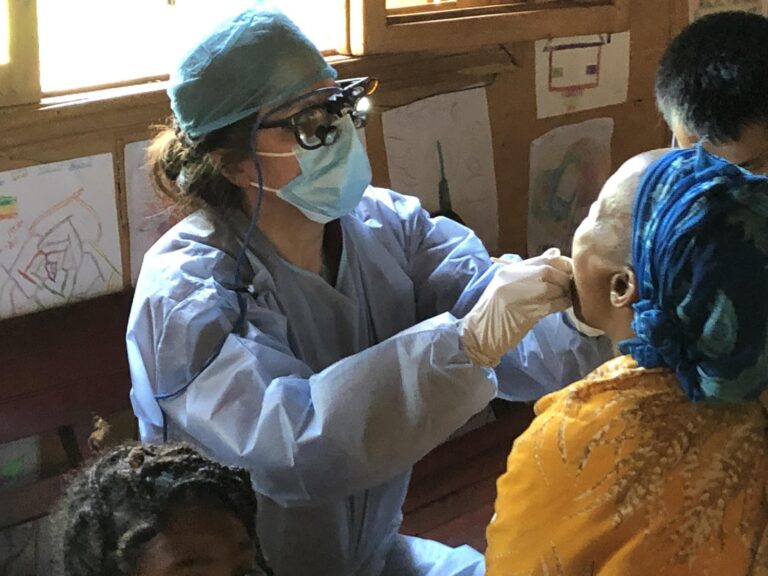
Dr. Moshtagh Farokhi, an Associate Professor in the Department of Comprehensive Dentistry, recalls reading about Dr. Albert Schweitzer as a pre-teen and getting inspired by his quest:
“You must give some time to your fellow men. Even if it’s a little thing, do something for others – something for which you get no pay but the privilege of doing it.”
-Albert Schweitzer
Her upbringing with a prominent orthopedic surgeon father who also served as a top executive for an international relief organization and a natural disaster trauma expert as a role model sealed her faith in serving others. Her family’s influence of providing relief for all segments of the underserved from Afghani refugees, orphans, homeless individuals, blind individuals, to street sweepers along with their philanthropical approaches to service called her to advocacy and service. Her path was paved early on to become a provider.
She attended the University of Minnesota (U of M) for the majority of her education. During the undertaking of public health as one of her undergraduate concentrations, she met an inspiring nursing faculty who further ignited her desire to serve as a healthcare provider. She chose to become a dentist because dentistry allowed her to implement her artistic abilities, while also satisfying her desire to serve. She attended the University of Minnesota School of Dentistry where two faculty members affirmed her ambition. One faculty mentor encouraged her to be the best dentist that she could while the other confirmed her need to attend to the underserved.
During her rotation at the UM-SOD Emergency Department, she completed residency training where she was introduced to interprofessional education approaches to healthcare. It was there where she realized teams who worked as an interprofessional unit were the most successful, even though interprofessional education was not “on the radar” as much as it is today.
Armed with those valuable lessons as she began her private practice years, Dr. Farokhi co-founded a pro-bono geriatric dental clinic with a retired dentist to serve the low-income elderly in Colorado. That experience was impactful because it taught her about elder abuse and patient advocacy. Later she completed a Masters in Public Health with a focus in dentistry. This era in her education was the most significant learning exposure of her career. As she recalls, “I learned so much about advocating for patients, public health campaigns, needs assessment, and focus groups, and completed a thesis that developed an oral health plan for Lanarkshire, Scotland.” The exposure to social determinants of health and active learning were also foundations that she received from the Glasgow University School of Medicine.
When she attended a dental public health residency at the University of Texas Health Science Center at San Antonio (UTHSA), all her prior experiences forged her next choices. First, as a resident, she participated in a pilot effort with the Texas Department of State Health Services to formulate an oral health plan for Texas, which is now referred to as Texas Oral Health Summit. Next, she gained knowledge and training on how to become an effective educator while completing a program at the UTHSA Academic Center for Excellence in Teaching, or ACET. During this time, she met and worked with a renowned educational specialist, Dr. John Littlefield, stating that “He changed the trajectory of my educational career.”
In keeping with Dr. Schweitzer’s philosophy of service to humanity, in April 2011, Dr. Farokhi joined forces with colleagues from the UTHSA schools of nursing and Long School of Medicine to operate an interprofessional collaborative effort aimed to raise oral/health awareness for the newly arriving refugees to San Antonio, while providing mentorship for future health care providers– the dental, medical and nursing students. This Student-Faculty collaborative effort, supported by the UTHSA Center for Medical Humanities & Ethics (CMHE), was named the San Antonio Refugee Health Clinic (SARHC) in honor of the population it serves. SARHC, with collaboration from San Antonio community partners such as Catholic Charities, St. Francis Episcopal Church, and the Center for Refugee Services of San Antonio, would become an empowering interprofessional setting of academic-community partnership. The mission is to maximize students’ educational experience by improving the health outcomes of this underserved population.
This oral health component of SARHC is the first point of contact for many of the newly arriving refugees in San Antonio to receive care. Since 2011, Dr. Farokhi has been volunteering to serve refugees in need of oral healthcare. “My vision for the oral health component of this clinic is to provide dental students with an opportunity to practice their diagnostic skills, promote oral health, and increase access to oral health care for the refugee patients while learning with and from the nursing and medical students and faculty. We are very privileged to work side by side with the nursing and medical faculty and students in providing a holistic health service approach serving people from all corners of the globe,” states Dr. Farokhi.
Dr. Farokhi and IPE students focus on empowering the refugee participants with access to oral health care in San Antonio by providing oral and nutrition health, oral cancer screenings, and complete head and neck exams, while explaining the screening results, tobacco cessation, and assessment of traditional smokeless tobacco use. Patients receive a tailored local clinic referral after the team assesses their current disease level status, existing oral health knowledge, and language skills at each appointment.
Through the years, the SARHC’s dental team has increased access to oral healthcare by way of culturally sensitive tailored oral health and nutrition education as well as tobacco cessation counseling where one out of every three patients seek oral healthcare. The additional urgent oral health clinics organized by Dr. Farokhi and the leaders of the Christian Medical and Dental Association of San Antonio are great examples of opportunities to serve a global population in a local setting. Dr. Farokhi’s oral health priority at SARHC has been oral health literacy for the refugee population. This rare chance of bridging the gap between theory and practice and working with other professional students and faculty have produced true fellowship and enhanced cultural humility training.
The experience has been a positive journey for dental students, with one student stating, “After a long dental school day, I have rejoiced in helping others in need as they helped me with their friendly smiles and reassuring voices, surrounded by my dental faculty and nursing and medical school friends, a strong reminder of my purpose.” For Dr. Farokhi, as she states, “There is no joy greater than serving the underserved, the community in need, and the IPE students. It is where all of my preventive expertise, lessons learned in cultural humility, and the joy of empowering the next generation of health care providers comes together. Dentistry has been the best professional fit for me. It has been my first job and where my passion to serve and to teach all come together. My greatest joy is when the students accompanying me in this journey graduate and formulate their own service-related efforts. I find it extremely rewarding when they contact me and want to share their accomplishments. The best rewards come in the form of student reactions, like when a medical student asked me to interpret for a patient his thoughts of – You have enriched my life today!”
She has traveled to Africa to attend to the underserved. To come full circle, she hopes to visit one of Dr. Schweitzer’s hospitals in Africa someday.
Story: Nasrullah Abdurrazaq, Moshtagh Farokhi, Photo courtesty of Dr. Farokhi