
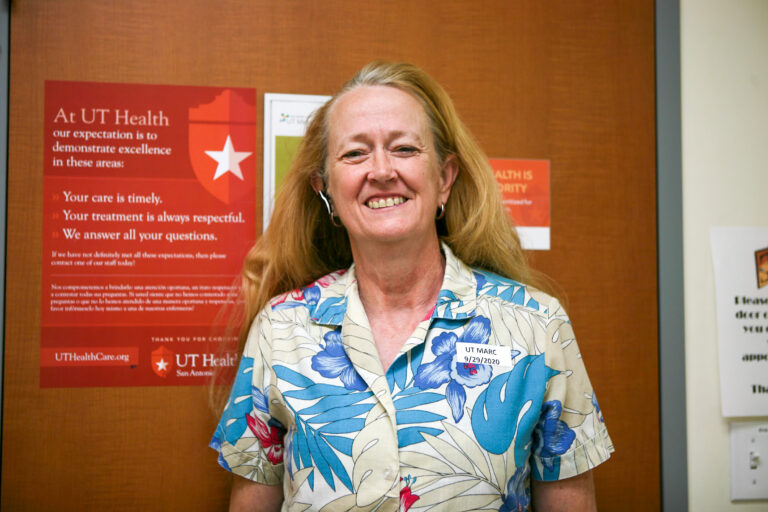
I spent 41 years in the Marine Corps. I decided when I was about 10 years old that I wanted to enlist and my father went nuts; no daughter of his was going to join any armed service, especially the Marine Corps. He stopped yelling at me after what felt like 20 minutes, even though it was probably only 2 minutes. I think he thought, “Wait. She’s 10 years old. Next week she’s going to want to be an archeologist. The week after that, she’ll want to be a lawyer,” because at that age, you change your mind. And I did want to be a lawyer, so I was really good at arguing and I argued with him until I saw that his stubbornness wasn’t going to end. I walked away and my mom who had been in the next room listening said she’d sign for me. I said, “no, you won’t. This is between me and him.” My mom thought I was just about as bad as it gets for stubbornness. It was almost genetic.
At 18, I came home one day and waited until we were sitting down for supper and everybody had a mouthful. And I said, “oh, by the way, I enlisted in the Marine Corps today.” My mom looked at my dad, thinking that I wouldn’t have done it if my dad hadn’t been so stubborn. I would have anyway. They ended up being very proud of me in the end, I’m sure. But they did spend the time from when I enlisted to going off to bootcamp telling me every horror story they’d ever heard.
I wanted to join the Marine Corps partly for the challenge. There were very few women enlisted at the time and I felt as though if I could do that then I could do anything in life. There were several times when I doubted myself. The toughest part was being able to follow instructions because I really didn’t want to. I had a bad attitude going in. I was tired of listening to men telling me how to run my life, starting with my father. It was partly the age- at 18, 19, 20, we think we know everything. And it’s not until a few years down the road that we realize that maybe we don’t.
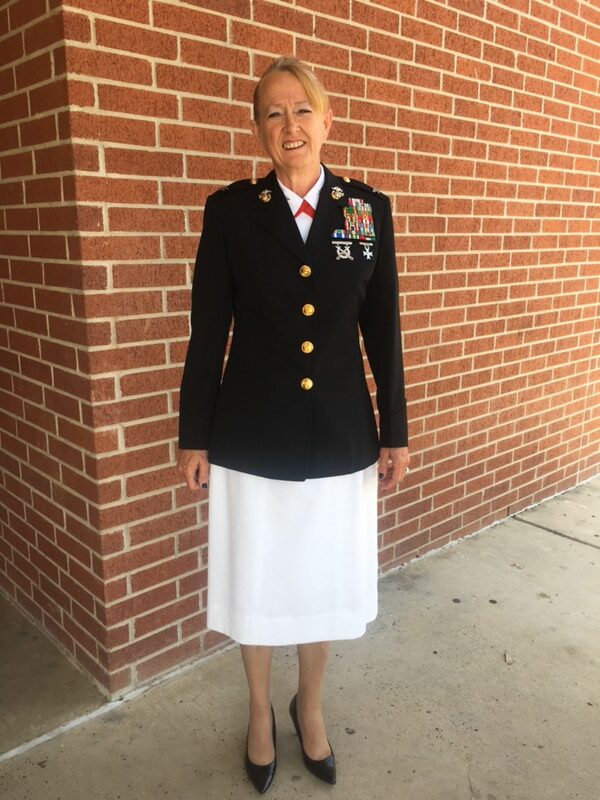
When you go to boot camp, the women train separately. Only recently have they combined the training, but they still live in separate barracks. So in boot camp, I was with several women. Then, I was the only woman in my unit. In fact, I was the only woman that had ever been in my unit to that point. That followed through a lot of my career. Even as an officer, I was one of very few in any particular unit. I felt like I needed someplace that I could make a difference in the world and I thought the Marine Corps might be a launching pad for that. Even if I didn’t stay, it would give me the foundation to make a difference.
I was in the reserves when 9/11 called me back to active duty. They sent me to Iraq and Afghanistan several times each over the next few years until I returned to the reserves. As a colonel, you can only have 36 commissioned years, and when I thought it was time for me to do something else, I retired. In the meantime, I had taken a job teaching Marine Corps Junior ROTC in Laredo.
While in Laredo, I found a lump and went to my gynecologist. I had been about 15 when I found the first lump in my breast. When I find them, I go to the doctor, ask them to check it out and get a biopsy. The results were always benign, fibrous lumps. No big deal. I thought this was another one, so I wasn’t in a hurry to get anything done.
But he sent me to a surgeon who did a needle biopsy and sent it off. I asked, “what does it look like? You’ve seen a hundred.” He warned me that it looked like cancer. That gave me a little bit of a heads up to start getting my attitude in line. When I went back a week or so later for the results, my physician confirmed that it was cancer and said he’d need to remove the whole breast. And I thought, “can we have a discussion about that?” I could feel the lump and I didn’t think it was that big of a deal. At that point, I had undergone surgery so many times that my right breast is smaller than my left anyways, so I didn’t have a problem with surgery. I asked if he could remove just the lump or only take half of the breast because I wasn’t ready to face it yet.
My physician put me on medication to shrink the lump so that we could do a lumpectomy and not take as much of the breast but it wasn’t shrinking. Then, I found a lump in the other breast. And I thought, “holy shit. Now what?”
I think I was in shock and didn’t recognize it. Even though I’ve been told before “this could be cancer” and “this probably is cancer.” Now it was cancer. I was prepared for the worst news but I still had a bit of denial and I shut down. When I told my friends, they said, “this isn’t you. You normally look at a problem and go, okay, we need to come up with a plan and then execute. You do mission planning. You’ve been a Marine all this time. Where’s your mission planning?”
I looked up the best research hospitals through the National Cancer Institute. I met with Dr. Tozzi in San Antonio. He said that a lumpectomy could be very disfiguring. I was aware that I could not make that decision. I’m not a doctor. I don’t know what’s possible and I don’t know enough about the procedures or how the cancer had spread to make the ultimate decision. I needed to trust the doctor that I had decided to trust, but I wanted to feel like I was a part of that process. Dr. Tozzi included me in the decision. He sat down, took lots of time with me, drew pictures and explained what everything was going to look like.
Even though it would be very disfiguring, I was comfortable because I could keep my own breasts. I didn’t realize at that time that my breasts were so defining for my feminine self-identity. I had just had a hysterectomy and I began to question. You’re taking all of my lady parts. Does that mean I’m still female? What does it make me if you take all of these things away?
I had so many questions. Dr. Tozzi connected me with Dr. Shah, a plastic surgeon, to decide if I wanted a breast reconstruction. I came into her office with a whole notepad of questions. She sat here and answered them all. That’s when I asked if I could see pictures of her prior surgeries, but she couldn’t show them. I was happy for her to do the reconstruction because I knew it would help with my self-esteem and self-identity, but I told her that she needed to take pictures of me throughout the process and we would sign the forms lawyers needed so that future patients could see pictures of her work. There’s a lot that patients don’t know. They don’t know the questions to ask. I didn’t.
I’ve really been blessed. It’s as though the universe has put people in my path that I needed to talk to. The surgery went great. Dr. Tozzi got it all. He checked the lymph nodes and it hadn’t spread there. I talked to the chemo and radiation folks and I didn’t need any but I didn’t want to start that party soon, too. A few weeks ago, I had a follow-up with Dr. Tozzi. He confirmed that there weren’t any lumps developing and he said, “see you in a year.” That meant I was cancer-free.
Things have gone smoothly except for COVID, which is frightening but I don’t usually catch colds or the flu because I don’t believe in them. That probably sounds strange, but I believe your belief system makes a difference in your health. When people would react negatively to my cancer diagnosis, I stopped them. I was going to beat this and not listen to any negativity because I didn’t need to be down for more than a minute. I’ve surrounded myself with very positive people and everybody at UT Health has been phenomenal. It’s made a huge difference.
Story: Claire Schenken Pictures: Sara Phoenix