

My mother is the oldest of 7 children, and her family grew up very poor in San Antonio. Back then, if you weren’t married by age 18, you were considered an old maid. My mother used to get in trouble for reading. She was the only bookworm of the family, and she got in trouble for being that way. She was forced to drop out of school in the 8th grade to become a hairdresser. She married my father, then had my sister and myself. She eventually went to law school when I was 10 years old. However, she had a lot of obstacles to overcome during that time in order to get to where she was. She always taught my sister and I to never rely on anybody. Whatever it is, you need to be able to support yourself in the lifestyle that you want. She always instilled in us the desire to have a higher education.
Medicine has always interested me. My sister and I both gravitated towards the sciences. I loved biology in school. I even liked chemistry, if you can imagine that. I found it interesting to learn about disease processes, and I wanted to go to medical school. When I was 23 years old, I was in school at UT Austin taking science classes to be pre-med, and ended up getting pregnant and getting married. My sister was in medical school already, and after seeing what she went through, I decided at that time that I didn’t want to be gone so much from my daughter. I ended up becoming a stay-at-home mom for 25 years, and had 3 daughters. I decided to go the nursing route so I could become a Nurse Practitioner (NP), and have more of a work-life balance. I got to stay home with my daughters until my youngest child was in middle school. I didn’t get my first NP job until I was about 45 years old. If I could change anything, I probably wouldn’t. I really cherished the time that I had with my kids. I got to take them to school, pick them up, and do a lot of activities with them that I may have not been able to do if I was in school.
Before I went to get my nursing degree, I wasn’t actively working. We had 2 children at the time. I decided to volunteer on the South side of town at La Mision. I wanted to see what I was interested in. I actually followed a NP there, and she did everything in general medicine. I was just fascinated. I loved her bedside manner. I felt that she really took the time to get to know her patients, speak to them, and educate them. I eventually started working as a Nurse in the ICU, and then I did home health. I didn’t stay with it long enough, and I was just trying to keep myself busy. However, when I became a NP, I told myself that I needed to work and learn. I eventually graduated as a NP from UT Health Science Center. My first job was with a family doctor in San Antonio, a UH clinic on the South side. Then, I went to USAA. They were hiring NP contractors, and I only stayed there for 8 months.
From there, I transitioned to University Hospital’s ER, and I was there for 4 years. It was a rude awakening, but I felt that I would be more well-rounded if I learned to treat the emergencies that I was sending patients off to. I wanted to be more comfortable in high-stress situations. I had to work hard to learn and prove myself. They started a residency program a year after I started, and I had to compete to perform procedures such as intubations and central line placements. I learned a lot in that position, and it was a good experience. Later on, a friend of mine had a job in the Plastics department, and I applied. At the beginning, I was more interested in aesthetics, but I quickly learned that there is way more trauma and reconstruction done at University Hospital. There was a Friday clinic in aesthetics that I was asked to run, but there was no formal training program setup for me. I had to seek out training opportunities and did a lot of learning on my own. I started out doing a lot of Google searches and using PubMed. You would be amazed at the resources that you can get off of Youtube. I had to figure out where I was lacking in knowledge and where I could find that knowledge. I took classes and courses, read a lot, and asked the physicians lots of questions. I am now at a point where I am comfortable and well-trained in non-surgical aesthetic treatments. I teach the residents and set up trainings for them. They didn’t get a lot of injectable training previously. I was able to bring that to the table.
You have to be confident in yourself and the way that you’re capable of learning the skill or the material. That will help you handle failure. Everyone will have something that doesn’t go as planned, and you must learn from the experience with humility. Make sure that you try your best to ensure that the same mistake doesn’t reoccur. Never lie. If you don’t know the answer to something, and you should know the answer to it, just say, “That’s slipping my mind right now, but I’ll make sure that I know for next time.” Once you’ve lied, people will lose trust in you and it will be hard to go back up. Always tell the truth, especially in medicine. And always be kind, not superior.
I plan to retire in the next 10 years. I do love plastics, and I’d love to get better at my skills. I’m trying to identify areas for improvement, to improve as a provider for myself and for my patients. I would like to be faster working in the OR. Practice makes perfect is 100% true. You may not be able to do it today, but if you keep practicing, you may be able to do it tomorrow, or the next day after that. Because plastics is such a big field, I’ve tried to improve in various areas such as getting my first assist in the OR, setting up trainings with the residents, and self-education as well.
A lot of people ask me how I do the job that I do, because of the things we see on a daily basis. I try to always keep the patient in mind as a human being, and not just another breast reduction or cancer patient. Be tuned into subtle changes that the patient may be dealing with. Make sure you’re not seeing a pattern of neglect or abuse, etc. You do become hardened sometimes, but you want to remember that you are part of a team and that you have to be a team player. One thing to always remember is that whatever job you choose in medicine, you will come to a point where you will get tired of it. Always reinvent yourself and see your job/patients in a different light. That will help you grow as a person.
Story: Janet Li, Photos: Amita Shah
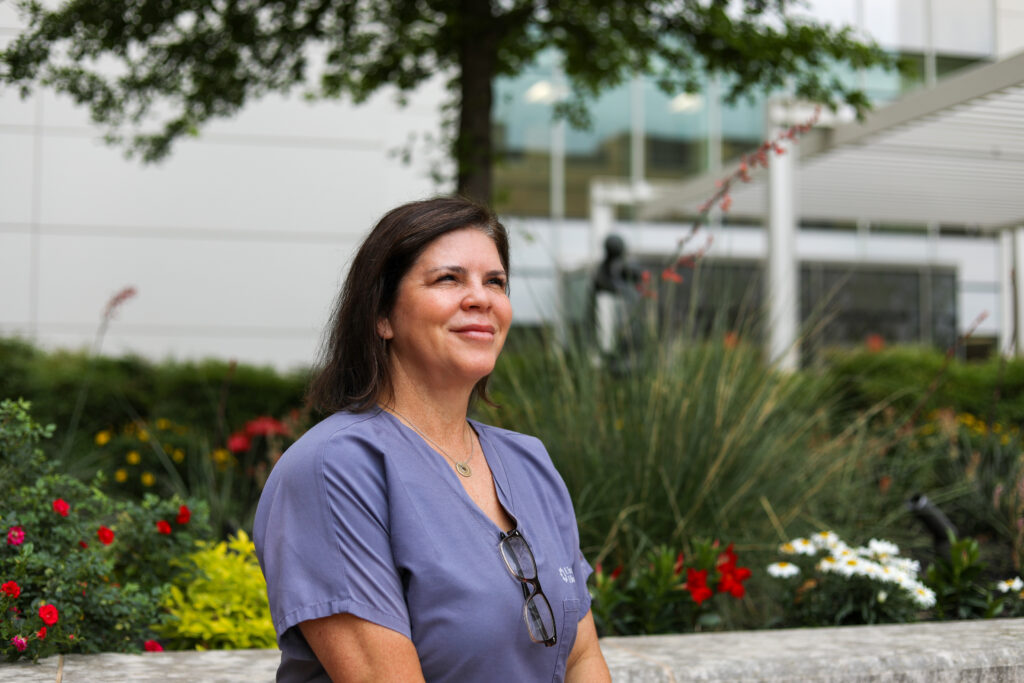
Lisa Lopez is a Nurse Practitioner at UT Health San Antonio in San Antonio, Texas. She currently works in Plastics and Reconstructive Surgery. In her free time, she enjoys doing yoga, cycling with friends, lifting weights, and spending time outdoors.
To book an appointment with Lisa for botox, fillers, or laser treatments, call 210-450-9220