
When I started medical school, I thought I would follow in my dad’s footsteps and become an ophthalmologist. I saw how he used his expertise as a physician to diagnose and treat all manner of conditions affecting the eye, and I was eager to achieve such mastery myself. Growing up, I loved to hear stories about patients rejoicing over their restored vision, and I hoped that I could make a similar impact.
I knew that ophthalmology was a competitive residency match, but I was already a very motivated student, so this did not bother me unduly. After the first year of medical school, I felt that I was still on track. However, at the beginning of my second year, I ran into a problem: I found myself really enjoying Mind, Brain, and Behavior, the pre-clinical neurology course at the Long School of Medicine. The fact that I was having fun studying neurology at that time was a surprise to me, as most of the rest of life did not seem to be going all that well. The COVID-19 pandemic was still raging with most of the world still in quarantine, I was healing from a stress fracture in my tibia that kept me from running (ironically, my stress relief activity-of-choice), and I was nervous about how my academic pursuits would have to change when my wife and I had Naomi, who was to be born in a few short months. Despite these challenges, learning about neurology re-invigorated my study for medicine. I found myself daydreaming about how I could enjoy a career in neurology, and I realized that I would never get tired of thinking about the nervous system and the diseases that affect it.
Still, it is not in my nature to give up on anything, and leaving ophthalmology behind felt a lot like giving up on something. Objectively speaking, neurology is an easier residency to match into than ophthalmology, and I wanted to make sure that I was not choosing neurology because I was afraid of a challenge. Counterintuitively, my answer to this dilemma came from studying dermatology. Among medical students, “dermatology” is almost shorthand for “about as competitive as you can get” in terms of residency matching. In January of 2021, I had my first experience formally studying dermatology, and to me, that was one of the longest weeks of the first two years of medical school. Different strokes for different folks; I am glad that there are people out there who are interested in dermatology, but I knew that beyond the basics, dermatology was just uninteresting to me. This experience shattered the quiet assumption I had been making that a competitive specialty must be my goal. If you reach high enough, you can find challenges to overcome and problems to solve in any specialty. For some, matching into the specialty is part of the challenge, and for others, it does not play as much of a role. Either way, you need to choose a field in which you are interested, and in which your talents, training, and modes of thinking can make a positive difference.
When I reflected on these things, I realized that I was not as interested in the subject and practice of ophthalmology as I thought I would be. On my surgery rotation, I did not like the operating room as much as I anticipated, and I realized that when I read about ophthalmology, I really only made myself do it because I thought I should. On the other hand, my third-year clerkship in neurology confirmed that neurology was the career for me. I loved interacting with the neurologists and neurologists-in-training, who were a diverse group of people who all shared an interest in an organ system that will always defy complete understanding. I loved learning about the different diseases that affect the nervous system and how treatment of those diseases continues to change as we learn more. Finally, I saw how compassionate, expert care delivered by a neurologist could make a positive impact on the lives of patients and their families, and the UT neurology faculty were excellent examples to follow in this regard. Neurology is weird, and it is unsettling when your loved one stops recognizing you, or doesn’t acknowledge one side of the body, or suddenly can’t talk, or starts seizing. With further training, I hope to deliver similar compassionate and expert care to patients, all while studying a subject that will always have another question to answer. Though I may have come to medical school for ophthalmology, I stayed for neurology.
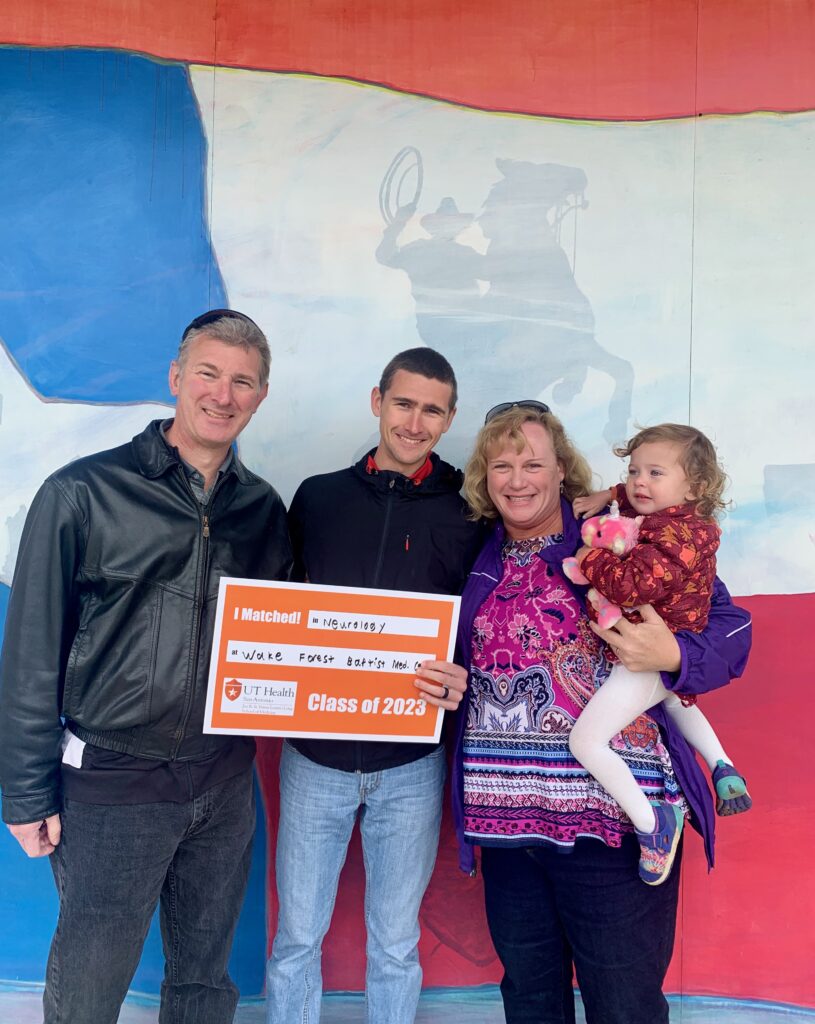
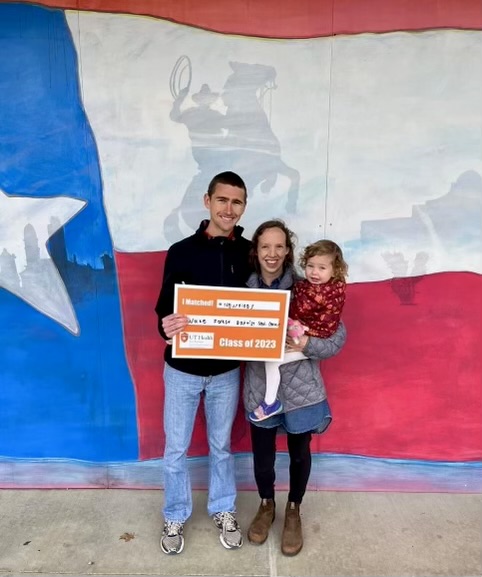
Will Young is a fourth-year medical student at Long School of Medicine in San Antonio, TX. He will be starting residency training in neurology at Wake Forest Baptist Medical Center in June 2023. He will be making the move to North Carolina with his wife, Hannah, and daughter, Naomi.
Story by Will Young
Photographs by Kelly Young