
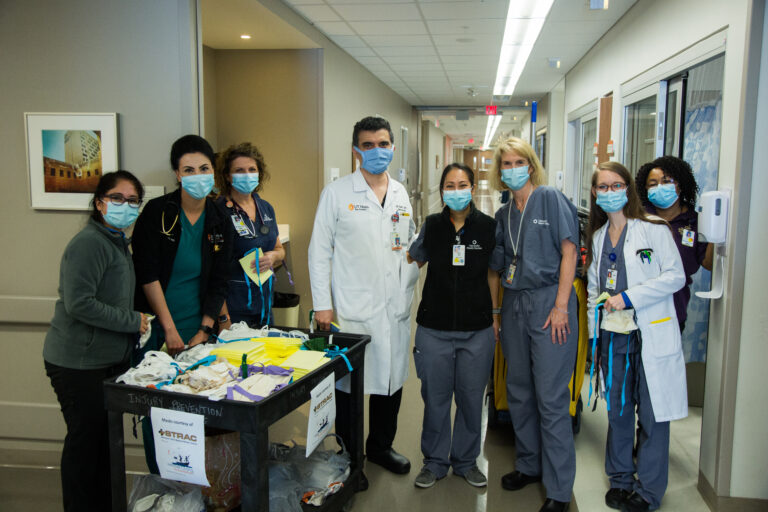
The limited amount of personal protective equipment (PPE) across the country during the COVID pandemic was all over the news channels, but when April Chang’s husband brought home his limited ration of surgical face masks he could use for the week and expressed his concern, it became more personal.
“Marvin doesn’t raise red flags often, so I knew this was serious,” said April Chang, founder and director of The Mitchell Chang Foundation. Her husband, Marvin Chang, is an anesthesiologist in San Antonio, TX. He is in a profession that is at high risk for exposure and contracting the SARS-CoV-2 virus, also known as CoVID-19. After hearing her husband’s concerns and talking with other health care providers, April knew the situation was real. On the evening March 20th, 2020, she sat on her living room floor and began planning how to pivot her non-profit foundation to supply fabric facemasks to health care workers around San Antonio.
On the same day, physicians of UT Health San Antonio and the Regional Medical Operation Center, led by the Southwest Texas Regional Advisory Council (STRAC), teamed up to identify and develop a suitable alternative to face masks that were currently being used. STRAC is designated by the Texas Department of State Health Services (DSHS) to coordinate all EMS agencies, hospitals, public health representatives, and emergency management leadership responses during a local health crisis. STRAC services over 22 counties in South Texas and its members include 74 general and specialty hospitals air medical providers, and over 70 EMS agencies. One of its roles is the oversight of health care resources, which includes assessment of existing PPE resources and anticipated needs during a public health crisis. By utilizing the personnel and resources within the university and city, the group developed contingency plans to mitigate the projected PPE shortages.
Citizens of San Antonio were encouraged to “stay-at-home” to slow the spread of COVID-19 but many wanted to do more. There were many individual efforts throughout the city to provide masks to facilities across the city. Grassroots efforts were organized through social media platforms by community members with physician liaisons. The two main groups on social media were SA Masks for Heroes run by Jennifer Gebhardt and Sewing Facemasks for San Antonio (SMSA) run by Keira Quarles and Amita Shah. The goal of the groups was distribution of masks within the San Antonio medical community and the response was overwhelming. By the first 24 hours, there were over 200 members in one of the groups and hundreds of masks had already been sewn.
These groups had different organizational structures, resources, and members, but all were able to come together safely and effectively to provide facemasks for the critical infrastructure of San Antonio during the 2020 COVID-19 pandemic.
The San Antonio community comes together
Community members made masks at home using their own materials but needed to know which health care facilities needed and wanted the masks. Due to the poor science on fabric masks and uncertainty of the masks’ protection and laundering protocols, hospitals were unable to formally recommend the use and distribution of the textile face masks, but members of individual hospital units requested masks to help extend the life of rationed masks.
The Mitchell Chang Foundation saw that it was difficult for volunteers to find materials and access them due to the stay at home orders. They wanted to limit the number of people that were driving around town to get the materials for mask making. To solve this, they put together mask kits that contained all the materials to make 6 masks and distributed them. April Chang coordinated for locations across the city that were closely monitored for collection of completed masks and distribution of mask kits. She also made contact with multiple hospital units and determined where the masks should be distributed. The foundation already had multiple volunteers who assisted with previous fundraising events and two were specifically educated on safe mask kit making practices. These practices were required to maintain strict safety precautions and monitoring to decrease the risk for contracting or transmitting disease. To assist with production of high-quality masks, seamstresses from around San Antonio were contracted to assist. These teams consisted of designers and sewers with studios that normally make wedding, fiesta, and quincenera dresses but were now out of work due to the cancellation of all events.
Facebook and other social media platforms were started by sewing enthusiasts to serve as collection and distribution organizers. But as the demand grew, it outstripped the resources of the individuals running the groups. Once The Mitchell Chang Foundation had set up their system, the Facebook groups started directing all their members to donate time and materials to the Foundation so there was a centralized, efficient organized system. After teaming up with the Foundation, these social media groups served as a way for people to discuss mask patterns, materials, and San Antonio-centric matters. Physicians volunteered to serve as liaisons to assist in answering safety and disease questions pertaining to the masks. The facemask social media groups were an easy way to get connected and often served as the first point of contact for local citizens to get involved in the effort.
The medical organizational response
The science behind fabric facemasks is not robust. This is a topic that has not been previously studied by the healthcare community at-large. There are articles that condone and others that condemn the use of fabric facemasks. The Center for Disease Control (CDC), World Health Organization (WHO), and US Surgeon General recommendations for the use of face masks also rapidly changed from discouraging the use of face masks by the public, to recommending universal face masking which made it difficult for the community members to figure out what was best and safest approach to take.
The community members were already starting to manufacture and distribute the masks on their own so the physicians wanted to get more scientific data on the fabric masks so they could develop best practices. The first goal of the medical organizations was to define what was an acceptable and safe fabric facemask design. Specific goals included designing a properly constructed face mask to offer both adequate filtration and limited permeability. It was also imperative that they were manufactured safely so they do not become a vehicle for disease transmission.
Different textile masks were sourced from community members and fashion designers around the community and evaluated by the medical team. Testing for particle filtration, permeability, breathability, and flammability was performed by scientists at Southwest Research Institute and basic scientists at UT Health San Antonio. After going through design iterations with the help of community members and garment designers, and testing, a final design was chosen and produced by local textile manufactures. The final design consisted of a 100% cotton dual layer mask with interfacing, a pocket for filtration, elastic ear loops or ties, a moldable nose piece, and a pocket for a removable filter. As results from the testing came back from the different masks and filters, the findings were shared with the community mask makers so they could adjust their designs accordingly.
The final design recommendations were posted on the STRAC COVID Response website and on the Facebook groups.
Getting masks to those in need
The community effort focused on providing masks to individual units in hospitals, non-profit organizations, and nursing homes. STRAC concentrated on developing masks for the critical infrastructure personnel such as the first responders and city workers. Because these people were involved in more high-risk situations, quality control and safe sourcing were critical. STRAC utilized its contacts throughout the region to contact companies that could produce high quality masks and the City of San Antonio ordered the STRAC designed masks for its critical infrastructure personnel.
By the time the CDC had recommended facemasks for everyone, the majority of hospitals that had requested masks had already received them. The Mitchell Chang Foundation continued their mask distribution efforts until April 18th. With a decreased demand, The Facebook groups remain open and members now are still able to organize the collection and distribution themselves on a smaller scale.
At the end of the April 2020, over 10,000 masks had been distributed within the community and the city of San Antonio had adequate PPE stores for its critical infrastructure workers.
The community groups had their resources of materials, sewing ability and creativity, and personal contacts throughout the city. The local medical community helped by resourcing large throughput facilities for manufacturing, scientifically testing masks, and giving scientific guidance for COVID-19 information and safe practices. This effort brought together community members that would not normally work together under ordinary circumstances. Through a coordinated effort of medical and non-medical resources, San Antonio was able to form a large and safe response to providing facemasks to the community to help protect our most critical resource, our health care providers. Fortunately, the San Antonio healthcare system has not been overwhelmed and traditional PPE resources are catching up to the demand, but if needed in the future, the community collaboration has shown that we are ready.
Story: Amita Shah, Photos: Sujaan Lal


Learn More about STRAC: https://sapeopleproject.orgsapeopleproject.org/www.strac.org/
Learn More about The Mitchell Chang Foundation https://sapeopleproject.orgsapeopleproject.org/themitchellchangfoundation.org/ https://sapeopleproject.orgsapeopleproject.org/www.facebook.com/mitchellchangfoundation
Join Sewing Face Masks for San Antonio on Facebook
https://sapeopleproject.orgsapeopleproject.org/www.facebook.com/groups/215727416292815
Visit SA Masks for Heroes on Facebook https://sapeopleproject.orgsapeopleproject.org/www.facebook.com/SAmasksforheroes