
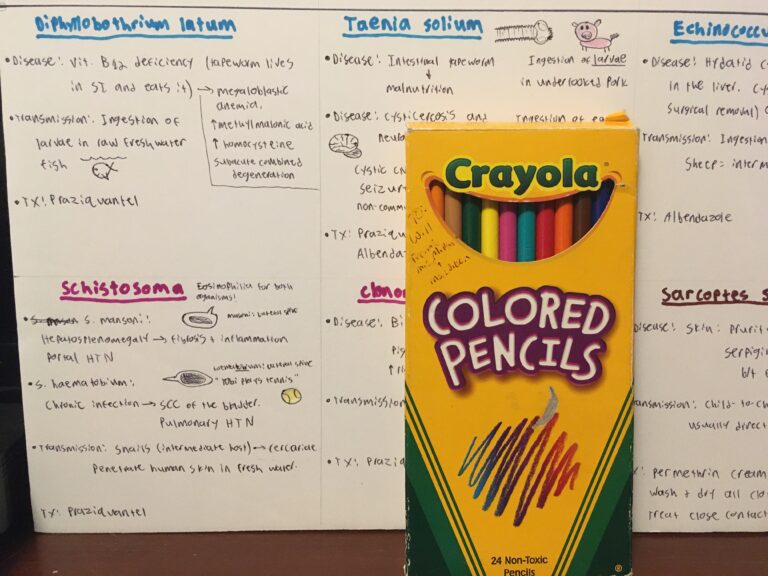
At the end of my second grade year, Ms. Millar and Ms. Wilson gave each student in their class a box of twenty-four colored pencils. Do you remember what it was like to open a new box of colored pencils as a child? Seeing all the impossibly uniform points lined up in perfect little rows, delighting in drawings yet to be conceived, perhaps even a bit wary of ruining that pristinely ordered arrangement of colors set in such a beautiful array. It was this latter sentiment that got the best of my eight-year old mind at the time; I could not bear the thought of taking this gift that seemed so important and meaningful to me at the time and consuming it like any other common box of artistic implements until those perfect pencils were disordered, ground down, and a mere shade of their former glory. No, much better to enjoy having those pencils rather than using them. I doubt my teachers knew the near-veneration I would assign to that box of colors; they certainly never would have guessed that those pencils would contribute to my education beyond elementary school, but they did. More on that later.
Several weeks ago, when I interviewed Maria Benson, a fourth year medical student going into neurology, she told me a wonderful story from her own life about a high school teacher who had made a huge impact on her life. She told me how on a science field trip to San Antonio, her biology teacher had given her the little push she needed to think about pursuing a career in medicine. It didn’t require that much effort on his part: being engaged enough to see an interested student, offering a bit of advice and some words of encouragement was all that it took. But because of that teacher’s relatively brief influence, Maria went on to study neurobiology, engage in research, go to medical school, and ultimately match into neurology. Along the way, she has been an encouraging guide to other students through the Veritas program at UTHSCSA and has already assisted in taking care of many patients as a medical student. Certainly Maria’s high school teacher was not her only important influence, or even a lasting one, but it is indisputable that he made a significant difference in her life, and through her the lives of countless other medical students and patients.
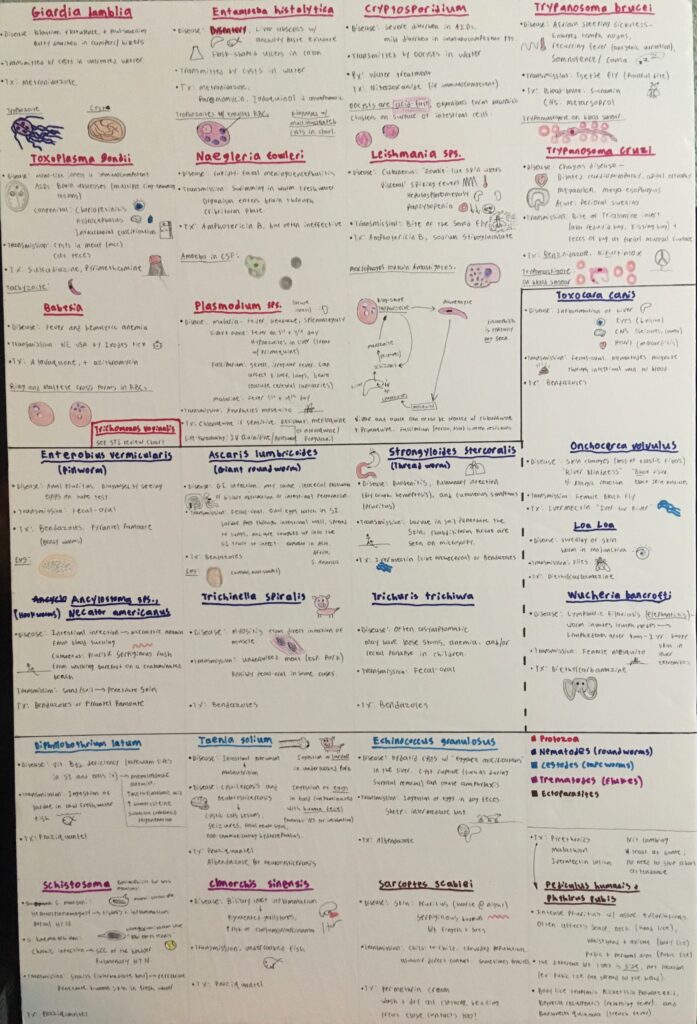
This spring, I unearthed that old box of colored pencils from my desk drawer. I was having a terrible time remembering all the parasitic infections I needed to know for the USMLE Step 1 exam, and I thought I had a solution: convince my brain that this list was worth remembering via illustration. I got a piece of posterboard, copied all the information on parasites from First Aid onto it, and then added colorful (and, I might add, extremely amateurish) illustrations. I forced my brain to dwell on each bug as I drew, and in the end I had a poster with a 4×7 grid where I could see all the parasites at once, with colorful pictures to remind my brain that this was something of interest. I am happy to report that at this time I am no longer randomly guessing for every parasite question, and I didn’t have to use a single mundane flashcard. The most remarkable thing to me is that fifteen years later, halfway across the country from where I used to live, Ms. Millar and Ms. Wilson are still helping me learn. The same teachers who taught me to do simple word problems are helping me prepare for the longest, most challenging test I have taken to date. I cannot help but give thanks for their simple generosity, both to me and to all the other students whose lives they touched.
There is a quote from Lin Manuel Miranda’s musical Hamilton that seems to describe this sort of situation perfectly. At the end of the show, facing certain death, Miranda’s Hamilton offers this soliloquy: “Legacy, what is a legacy? It’s planting seeds in a garden you never get to see…” Teachers in our community and across the world exemplify this truth on a daily basis, but this opportunity to leave a legacy that you might never get to see is available to everyone. Where is your garden? What are your seeds? Are they a few well-placed words of encouragement? Are they a box of pencils that will be treasured more than you could possibly imagine? Are they something else entirely? The possibilities, like the potential impacts, are nearly limitless.
Story and photos: Claire Schenken