
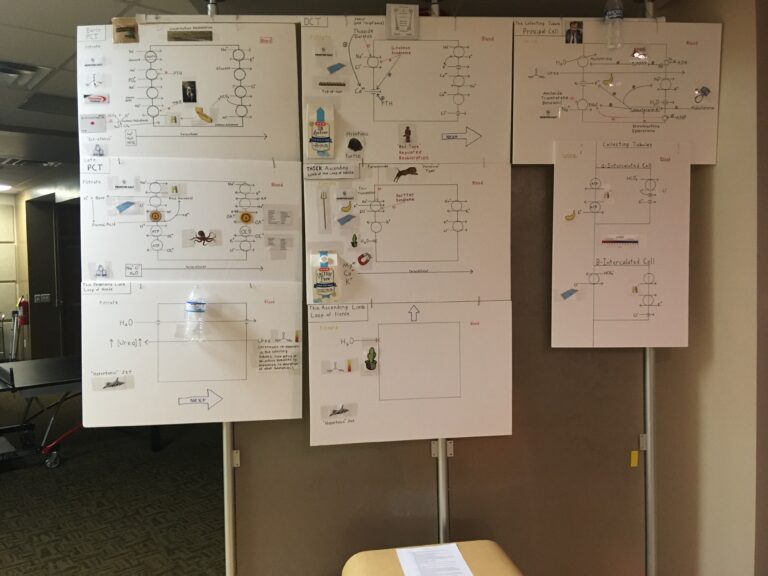
At the risk of stating the obvious, medical school is hard. The sheer volume of information to learn in a relatively short time is simply overwhelming, even for the most dedicated students in the best of circumstances. Needless to say, this past year has not been “the best of circumstances.” I created my nephron map as a way to help the MS1s in their renal module and also the MS2s studying for Step 1. Both of those groups have had to face major academic challenges since the pandemic began, and I wanted to do something to help make student life just a little better. Kidney physiology is very memory intensive just because there are several different parts of the nephron and each of them have different transporters that are unique to those specific segments. Learning it for the first time and reviewing it along with lots of material is pretty difficult to say the least.
I’m a big believer in taking things that you want to remember and putting them in the real world. Our brains are not video recorders; if you want to remember something, you have to attach significance to it, and it’s really hard to do that the things you are trying to remember only exist on a screen (from the student’s perspective, at least). Personally, I study by transcribing things. I kill a lot of trees, but it helps me remember. I was thinking of doing basically the same thing with the nephron but adding additional memory hooks.
In addition to putting the model nephron on a big poster board, I also added pictures to represent the various parts of the nephron. For example, if a certain part of the nephron had isotonic reabsorption, I had a picture of an ice cube; if it reabsorbed calcium, I cut up a milk carton and tacked it onto the poster just to help make it more memorable.
Ideally, I would have liked to distribute each poster in space, allowing students to walk from one part of the model nephron to the other, allowing them to associate each symbol with a different location. I am a runner, and over years of running in many different places, I have discovered that staring at a map only goes so far in helping you memorize a route; if you really want to understand where you are, you have to run it, sometimes several times. That method does initially require a bit more effort than reading a map, but after only a few reps, you often find that you have memorized the route without hardly trying, and that memory has much higher fidelity than staring at the map ever would have provided. In reality, space for the model nephron ended up being limited, but in future iterations I would love to add a location element to help students even more.
Right now, the project is hanging in the med student lounge next to the foosball table. So every time you score a goal, you can refresh your memory of the nephron, which I think is a nice unintended feature.
Fun fact about Will: his favorite part of the loop of Henle is the proximal convoluted tubule just because it’s like the workhorse- it’s reabsorbing most of the volume and it’s setting up the rest of the nephron for success. If the proximal tubule is broken, then the rest of it’s just not going to be able to catch up.