
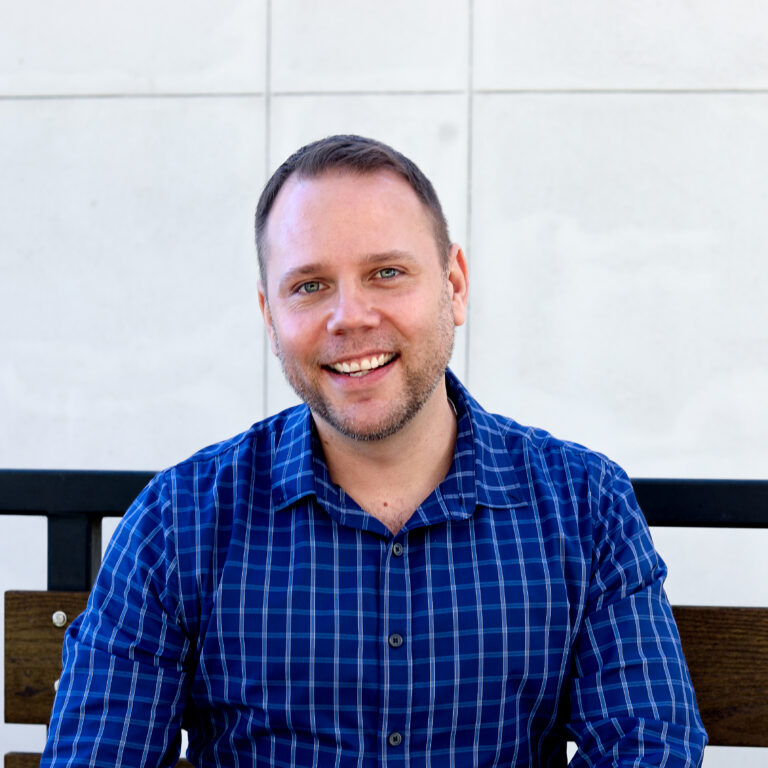
“As long as I can remember, I’ve had tinnitus. I don’t know what silence is like. I can’t say what my reaction would be if I experienced silence – I think it might even be scary.
Tinnitus is a neurologic condition where there is ringing or noises in one or both ears and there is no known cure. As a child, I was told that there was nothing I could do about it, so I just learned to live with it. In college and grad school, I noticed that when my stress increased, my tinnitus would be more apparent. I would tell my friends, “My tinnitus is on fire, it’s really bothersome for me”.
I didn’t decide to focus on tinnitus research until I was in graduate school for my PhD in Psychology at the University of Wyoming. I was a teaching assistant in a class for chronic health conditions and gave a presentation about tinnitus. My mentor encouraged me to research it more. When I read more literature about it, it was fascinating. There isn’t much research about it, but there is evidence that cognitive therapy can help functional outcomes. Tinnitus can lead to psychological impacts in domains such as concentration and sleep. I was interested in if there were implicit attitudes that maintained tinnitus. For example, if I thought there was something wrong with me, the emotional response would be anxiety, concern, and even panic. These responses can promote further reactions and cause increased interoceptive awareness, which is being in-tune with bodily sensations. If I’m having these thoughts and these negative emotions, I may be perceptive of my tinnitus even more. This spurs on this awful cycle between thoughts, emotions, and interoceptic awareness and I wondered, ‘Is this a factor that contributes to tinnitus?'”
Researching Tinnitus
I tested the connection between Tinnitus and implicit attitudes towards it by using an implicit association test (IAT) which was originally developed at Harvard for racial biases. Before people took the test, I primed them by telling them to think about their tinnitus or not. Then, I paired words with negative and neutral stimuli. Nothing showed up except, if they were primed about their tinnitus, their implicit attitudes were significantly more negative toward tinnitus. This made me want more training on the neurological aspect of tinnitus.
I started doing experiential kinds of exercises on myself based on principles of acceptance and commitment therapy. It’s weird because when we go to sleep, we don’t think about paying attention to stillness. By doing this, I’ve been getting to know my tinnitus. Instead of it being this scary anomaly that I don’t want to know, why don’t I get to know it? Maybe even welcome it because I know I can’t get rid of it. This is a different approach because therapies that are currently done for tinnitus are introducing sounds to mask it. Instead, I sit in quiet and get to know it. It was scary at first, to be honest. I didn’t know what would happen, if it would make it louder, it was going to get worse, what would happen? I had to recognize that those were just thoughts. They don’t have to be real. There’s no justification for those thoughts which made it easier. Now, I know the pitch of my tinnitus and I know how loud it is in quiet environments. Sometimes in my office I can hear the buzzing of the lights, but I can also hear my tinnitus and that’s ok. I don’t have to avoid it.
The Bio-Psycho-Social Model of Tinnitus
Most patients with tinnitus are not bothered by it and it doesn’t affect their day-to-day function, but for the 5% that are extremely bothered by it, they will need intervention. The bio-psycho-social model is if we feel better psychologically, we are going to feel better with the physical aspects. We have to start somewhere, so if we are able to make patients feel psychologically better maybe we can gain traction on improving a person’s level of functioning and tinnitus-related distress.
Progressive Tinnitus Management (PTM) is the gold-standard therapy for Tinnitus and was developed by James Henry at Oregon and National Center for Rehabilitative Auditory Research (NCRAR). PTM is a step-wise approach where they integrate sound therapy and changing thoughts and feelings about their tinnitus. Other evidence-based therapies for tinnitus are mindfulness-based cognitive therapy or acceptance and commitment therapy (ACT). If they reframe their thinking that this is a neurologic condition and not something wrong with them, the responses are not as negative. They aren’t as reactive to their tinnitus and it has less negative effects on cognition, sleep, and concentration.
For our last year of doctoral training, we do a matching process similar to what physicians do for residency. I matched to the University of California at San Diego School of Medicine and San Diego VA. There, I learned therapeutic techniques that improved PTSD – Cognitive Processing Therapy (CPT) and Prolonged Exposure (PE). The therapies work well and I loved working with these patients. The research shows that with these approaches, after 12 sessions, about 50% no longer meet criteria for PTSD, and an additional 35% still have PTSD, but are functioning much better and are happier. Many of these veterans had been struggling with this most of their lives and after 3 months, they were able to trust themselves and others. With CPT, we use a Socratic approach which applies logic to their thoughts to change their emotional and behavioral responses. If their thought is “If I had done XYZ, my friend would not have been killed”. We then go back and see if that is a true statement. In a traumatic event, how was your body responding? How much time did you have to respond? Is it reasonable to expect that you would have done XYZ?
If they have a thought that they should have done something differently during a traumatic event, then their self-trust may be shattered and they apply that to a whole host of different situations. The thought can become “I can’t trust myself at all”. We then start exploring if that’s true or not. We ask “If the thoughts are causing you a lot of distress and are inaccurate, why do you want to keep them around? Let’s find other ways of thinking about it.” Our aim for patients is to develop a balanced and realistic way of thinking, experience natural emotions associated with trauma, and accept the event as it happened.
Connecting Tinnitus and PTSD
I loved doing this type of therapy and this patient population, and my experiences at UCSD and the San Diego VA influenced me to pursue PTSD research. As a post-doc at UT Health, I focused on PTSD and saw the same positive outcomes I saw while at UCSD. Although I was focused on researching PTSD and the factors that worsen and improve symptoms, I started seeing overlap with tinnitus. Tinnitus in veterans can be caused by loud noises, acoustic trauma, traumatic brain injury, weapons, IEDs, RPGs, and aircraft. Not all people develop tinnitus even if they have similar exposure. There doesn’t seem to be a lot of overlap between an auditory disorder and PTSD, but when I worked more with veterans with PTSD, I noticed overlap in the symptoms of the two, namely, avoidance, hyperarousal, negative cognition and beliefs. During my training, I found that treating PTSD can help improve tinnitus. I started asking how does PTSD affect tinnitus? What is going on inside the brain? What regions of the brain are being activated? What is similar, overlapping, versus what is different? Since there are a lot similarities with both, and I wondered if I just treat PTSD, will I see tinnitus-related distress decrease? Our study did show that if we treated PTSD, we improve tinnitus-related distress. Although we didn’t have enough patients for the results to be statistically significant, it had an effect size of 0.9 on tinnitus related symptoms, which is huge. The next step is targeting the brain region involved with tinnitus. If we can localize it, can we target it to cure tinnitus? It’s a lofty but needed goal.
Learning to live with a chronic condition
There’s a lot of overlap between chronic pain and tinnitus. It’s a chronic problem, and even if you can’t get rid of the chronic condition, you can engage in strategies to alleviate some of it. That’s what led me to do a more mindfulness-based approach in dealing with not only my tinnitus, but overall – I am not my thoughts or emotions, and I can have these experiences at the same time. This approach incorporates eastern philosophy. We can have these experiences and still follow through with a value-based life.
Values are different than goals. If I value teaching and education, what is it that I’m going to do to fulfill that value? If I value my friends and family, is my tinnitus going to get in the way? My emotions are there and they don’t have to be positive or negative. They can be pleasant or unpleasant, but I am not my emotions.
The underlying implication of an emotion that you “have to avoid” is that it’s negative. It can be unpleasant, but if I don’t have to avoid it, it can stop interfering with my life. This starts contradicting some of the underlying cognitions of chronic conditions.
An example I like to give is if you’re pushing against thoughts or chronic pain, you’re concentrating so much on pushing against it that you’re missing everything around you. If I accept it and stop pushing against it, I still have it with me but I can put it on my lap, I can put it in my pocket and it is no longer my focus. I can pay attention to all the things around me. It becomes neutral and I can do whatever I want with it. I have generalized this to other parts of my life when I have to deal with unpleasant emotional experiences. Just because I have a thought, it doesn’t mean anything. They have done some studies where 95% of people have endorsed really messed up thoughts and I bet the other 5% were just not willing to admit it! The brain is just the brain and it will make up these random things! Thoughts are noise that we can recognize and know that it won’t stay forever.
Integration of Mind and Body and the Impact on Health Outcomes
My previous research focused on the integration of mind and body and how psychological factors can impact health outcomes. In grad school I researched psychosocial factors that contributed to HIV transmission in men who have sex with men. I thought that was a great area to invest in. I didn’t know what I wanted to focus on, but behavioral research was the general area I thought I wanted to be in. The students in our lab called ourselves the Sex, Drugs, and Rock and Roll Lab, because another area we focused on was psychosocial factors contributing to methamphetamine use in women in rural Wyoming. We looked at the social factors that contributed to the initiation of meth use because if we know what promotes it, we can start implementing interventions to help people keep out of it. The stories we heard were heartbreaking. Some were introduced to meth from family members, intimate partners, and even their jobs. Another area we looked at was condom use in college population. What we saw was the “better than average effect” also known as “downward social comparison” – “I would use a condom, but they wouldn’t” – which could lead to blaming people for acquiring a sexually transmitted illness. By focusing on these behavioral aspects, we could decrease the rates of transmission not just in rural areas, but everywhere. It’s all about harm reduction.
This can be controversial. An example of this is the needle exchange in San Francisco. By providing a safe space we can decrease the risk of transmission of disease. We look at how we can help people in slight ways to change their behaviors, which can lead to greater behavioral changes in the future. As we help others and decrease disease burden, it helps preserve resources, and we can use those resources to help others. It’s not just about changing individual behaviors, it’s a public health issue.
Representation as a Public Health Issue
Another area I was able to study was HIV transmission in Tanzania where homosexual behavior is illegal and punishable. What we learned from studying what was happening there can be applied to the US. For example, when gay people are demonized, denied basic rights, and there is an underlying anti-gay sentiment, it is dangerous in a public health aspect. For example, we saw that some Tanzanian truck drivers would engage in homosexual behavior when away from their families and then bring HIV back home. It’s really dangerous. If they were accepted, they would not feel that they would have to hide their behavior, would feel better about themselves, and engage in safe practices.
These microaggressions and implicit messages have big implications. For many in the LGBTQIA+ community, they may perceive that they are wrong, are imperfect, or disgusting. They could try to repress aspects of themselves, which causes negative side effects. We have seen this with conversion therapies, which are now banned by APA because of the negative side effects it causes. The therapies cause more harm and increases in suicide and self-harm rates. Lack of self-acceptance carries shame. The body responds with psychological and physical stress. For some, the best way to avoid the anti-gay sentiment is drug and alcohol abuse because it helps alleviate the anxiety of going forward with gay sexual activity. It’s heartbreaking. They are internalizing the anti-gay sentiment which leads to difficulties with day-to-day functioning. Representation as a public health issue is how I’ve been conceptualizing it. If we were to have more representation, then people would be able to normalize aspects of themselves and not feel so isolated and have negative reactions. This is why we need more representation in media and in the workplace – so people can be empowered to live the lives that they want to live.
I don’t think people realize the importance of representation. It’s not just about having a gay, black or trans person on TV. It’s about what it means for people in those communities to see that they can also achieve those sorts of roles or career opportunities. I think it is changing and getting better but I think we can do a lot more. I’m excited about it.”
Story/photos: Amita Shah
John Moring, Ph.D., is a licensed clinical psychologist and an assistant research professor within the Department of Psychiatry at the University of Texas Health Science Center at San Antonio. He completed his doctoral degree at the University of Wyoming in 2013. His focus of research included psychosocial factors that facilitate health-related behaviors, as well as the genesis and maintenance of tinnitus. He completed his pre-doctoral internship at the University of California San Diego School of Medicine and San Diego VA Healthcare System and later graduated from the STRONG STAR Multidisciplinary PTSD Research Consortium Trauma Fellowship. During fellowship, he obtained extensive training in the treatment of PTSD and the behavioral and emotional sequelae of traumatic brain injury. Dr. Moring currently investigates the shared and unique neurobiological mechanisms between tinnitus and PTSD, as well as shared and unique symptoms and distress between both disorders.